

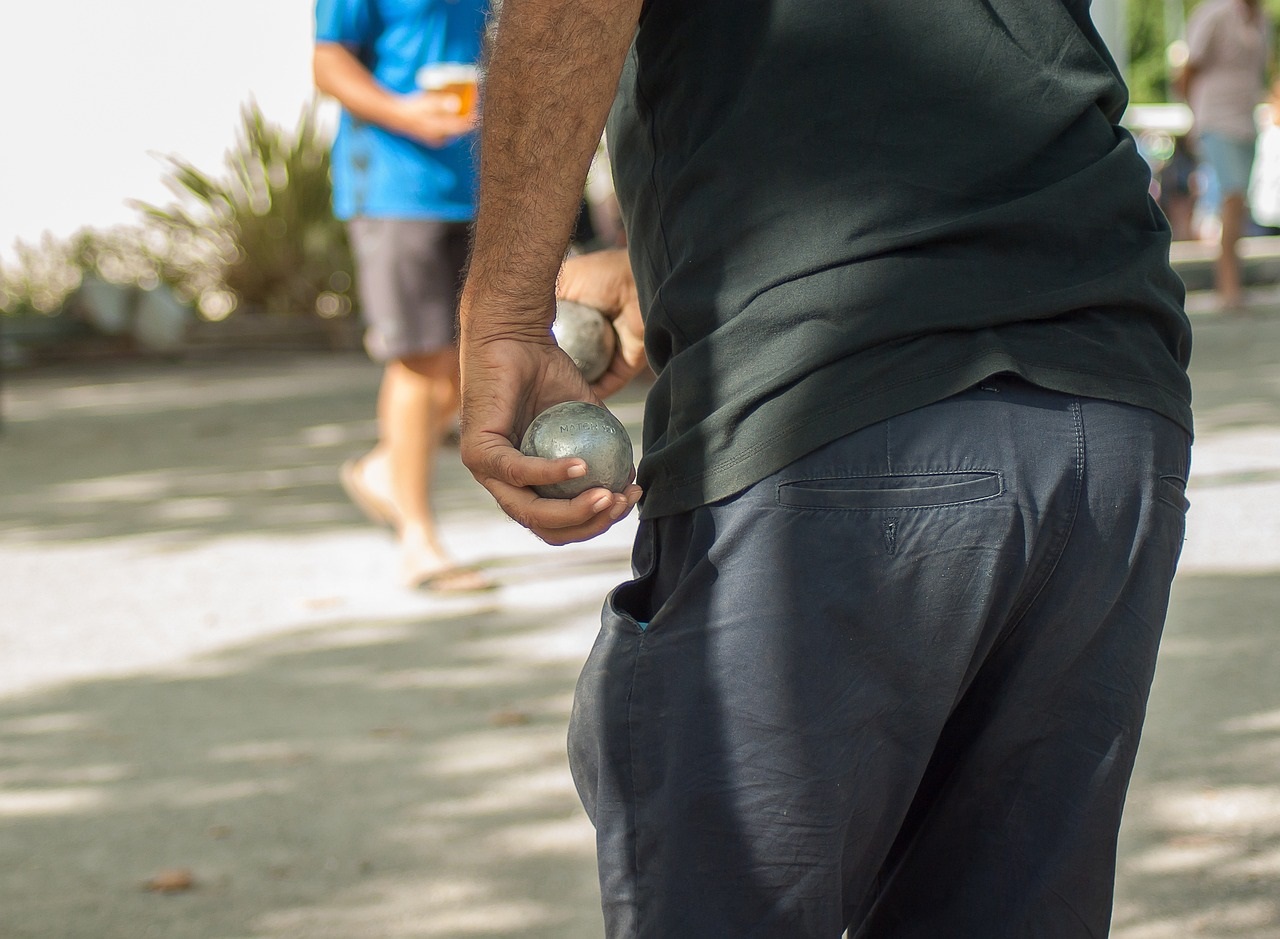
The popularity of ball games dates back to ancient Egypt. Stone balls were used to play on sand/grasslands, and these traditions were passed down from ancient times to the Roman Empire. Rome then fine-tuned the games, and some of the balls were made from wood. Pétanque game was derived from one of these ancient ball games.
Rules of Pétanque
Pétanque is a game first discovered in La Ciotat, Southern France, in the early 1900’s. The game was derived from a popular Mediterranean game called Boules. The word “pétanque” is a petanca derivative, meaning “foot fixed.”
It is a Lawn bowling game played on uneven ground using metallic balls (usually made from steel). In French, the game is called Jeu de Boules. The game uses a target called the cochonnet.
For it to work, there must be at least two teams to play the pétanque game, and they must each have two sets of marked boules. There can be a maximum of 6 Boules in the game. With the Boules being split equally, players can form teams of one, two, or three people. The only other equipment required is a little ball known as the target or cochonnet. Pétanque’s specific rules are:
Draw a Circle
The Pétanque game requires players to draw a circle with a 25 cm radius. The circle can be replaced by a coil/rope if you have one available.
Team One Plays a Boule
A player from the first team steps into the circle to throw the ball at the cochonnet. They must attempt to throw the ball as close to the cochonnet as possible. This is usually over 6 meters away from the circle.
Team Two Plays Next
The next team tries to throw their Boule as close to the first team as they can. If they cannot throw the Boule, they must keep trying till they have successfully made a pass that’s as close to team one’s boule as possible. When they do this, the play returns to team one.
Continue Playing Until All Boules are Exhausted
The game of pétanque doesn’t end until a team has used up all their Boules. Once this happens, the power team can throw all their Boules.
How to Determine the Winner
In this game, the winner is decided by the Boules’ proximity to the cochonnet. The team with the highest number of Boules closest to the cochonnet wins. When the winner has been decided, they draw a new circle around the cochonnet and throw it again. The overall winner is decided when one team gets 13 points. There may be slight variations of the game but the rules are generally the same.
Pétanque is a fun game that has evolved from the centuries-old Boule game. Furthermore, the game isn’t restricted to a particular age so everyone can enjoy it. It is a family game and a fun sport for a casual outing with friends and loved ones. Pètanque is also recognized as a sport by the International Olympic Committee.
