

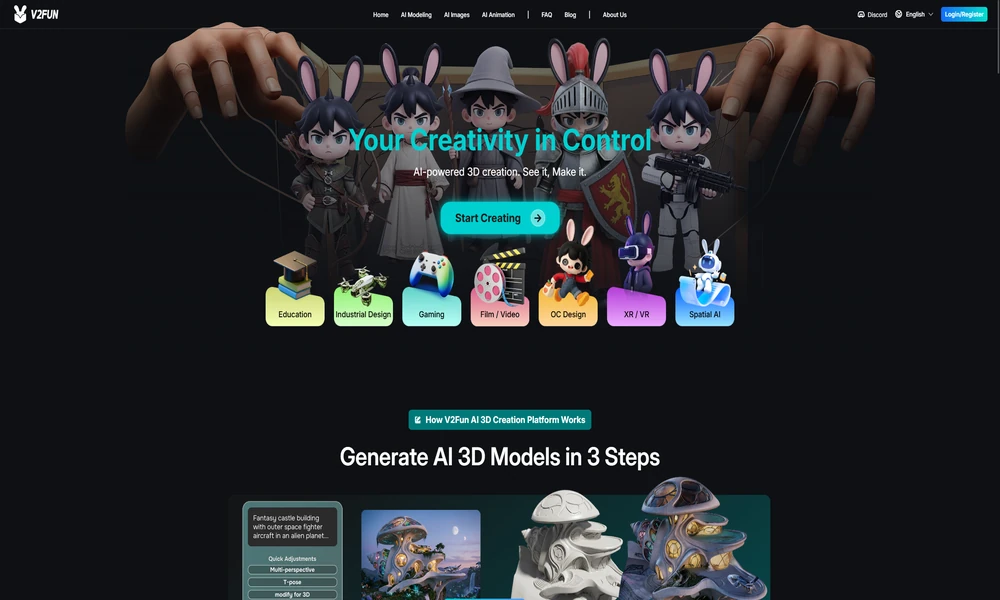
V2Fun is a browser-based AI 3D creation platform that can support early game-prop ideation, visualization, and downstream export workflows. It allows users to start from text prompts or reference images, generate 3D models, use multi-view workflows when structure matters, and export assets into downstream tools such as Blender, Maya, Unity, or Unreal Engine. For game props, its main value is speed at the front of the pipeline: it can shorten the path from concept to a usable draft that is ready for review, cleanup, and engine-side testing.
That distinction matters because props are easy to overrate in preview form. A crate, sword, lantern, collectible, or vending machine can look convincing in a render and still fail when you inspect scale, surface quality, thickness, intersections, or editability. The right way to judge an AI prop workflow is to ask whether it produces a usable asset for downstream work, not just an attractive first image.
Start with the production quality bar
Before you call any generated prop useful, define what “ready” means inside the game it is supposed to enter.
A production-ready prop usually needs:
- A readable silhouette at real gameplay distance
- Stable large surfaces rather than melted or noisy geometry
- Believable thickness on thin parts such as handles, straps, blades, or antennae
- Detail that supports the object’s function instead of creating random visual clutter
- Multi-angle consistency, especially for interactable or reusable assets
V2Fun can help here, but only when the generation path matches the asset type.
For prop workflows, the safest input path is usually a reference image plus a short prompt. That gives the model stage a stronger structural anchor than text alone. If the asset is a hero prop that must hold up from front, side, and back, multi-view generation is the more serious route. Text-to-3D can still be useful for rough concept exploration, but it is usually weaker as a final production path because it leaves too much structure to invention.
V2Fun’s published time estimates illustrate its early-stage iteration focus, but they should not be treated as production-time guarantees. The platform describes some generation paths at around 2 minutes and a beginner image-to-animatable flow at around 10 minutes. Those numbers matter because fast iteration is valuable for prop design. But they do not remove the need for production review. A generated prop is still only an early asset until it survives structural and downstream checks.
Check whether the asset is editable and exportable
A game prop is not ready simply because it exists as a mesh. It also has to survive the handoff into the tools where real production work continues.
This is where V2Fun becomes more useful than a pure visual generator. It exports in standard formats such as GLB, FBX, OBJ, USDZ, STL, 3MF, and PLY, which gives teams a practical route into Blender, Maya, Unity, or Unreal Engine. For prop workflows, GLB, FBX, and OBJ are usually the most relevant export paths because they are easier to inspect, edit, and test in common DCC and engine environments.
V2Fun also includes automatic retopology, target polygon control, and triangle or quadrilateral structure choices. That matters because many AI-generated props fail after the idea stage, not during it. A model can look acceptable in preview and still collapse as a production asset if the mesh is too chaotic to clean up efficiently.
A prop is closer to ready when:
- The mesh imports cleanly
- The structure is usable without full reconstruction
- Cleanup is local rather than foundational
- The export format already matches the next tool in the chain
It is not close to ready when:
- The topology must be rebuilt from scratch
- The scale is fundamentally wrong
- Major surfaces need re-modeling
- The prop cannot be edited efficiently after export
That is the difference between an asset that saves time and an asset that only postpones manual work.
Treat rigging and animation as a separate pass
Many props do not need rigging at all. Static environment assets, collectibles, inventory items, and decorative world objects live or die on geometry, material quality, scale, and export fit.
But some game props do move. Hinged devices, weapons with mechanical parts, mascot objects, animated gadgets, and character-like items can push the workflow into rigging territory. In these cases, the key question is whether the asset’s movement needs fall inside the platform’s current rigging scope.
V2Fun supports humanoid auto-rigging, animation production, motion upload, Motion Library use, model upload, and video motion capture. Those are useful capabilities when the asset is humanoid-adjacent or when the goal is a quick motion preview. But the platform also limits its current rigging focus to humanoid character models rather than quadrupeds or other non-standard structural models.
That matters for prop teams because many moving props are not humanoid at all. Mechanical linkages, creatures, stylized machines, or custom interactive assemblies often need very different rig logic. In those cases, V2Fun can still be useful upstream for concept generation or rough blocking, but a dedicated animation or game pipeline still needs to handle the final rigging work.
The same caution applies to motion input. V2Fun supports BVH and VMD uploads, as well as single-person MP4-based video motion capture. Multi-person motion capture and direct finished video rendering are described as future directions rather than current delivered production features. So if the prop depends on custom mechanical behavior, multi-actor interaction, or complex animation logic, traditional animation and game tools still need to lead.

Do not assume commercial rights are already cleared
Production readiness is not only about mesh quality. It is also about whether the asset can safely move into paid use.
V2Fun’s FAQ states that Pro plan and higher plans are expected to include commercial usage rights. That is useful, but it is not the same as saying every output on every plan is commercially cleared by default. If the prop is headed into a monetized game, a client deliverable, or a marketplace product, the plan terms should be verified before release.
There is also a separate input-rights question. Even if the platform terms are acceptable, prompts, reference images, branded shapes, licensed designs, and client-owned IP still need their own review. A clean export does not solve an unclear ownership chain.
For practical production use, teams should keep track of:
- The plan tier used at the time of creation
- The prompt and source inputs used to generate the asset
- The export version that entered the game pipeline
- Any manual edits that materially changed the result afterward
That recordkeeping helps prevent a fast generation workflow from becoming a slow legal problem later.
Final verdict
V2Fun is a strong option for AI-assisted prop creation when the goal is early asset development, fast iteration, and clean export into downstream tools. It is most useful when the prop can be judged as a mesh first, cleaned as needed in a standard DCC or engine workflow, and approved only after it clears real quality, pipeline, and rights checks.
Use V2Fun as a strong early production option when most of these are true:
- The prop reads clearly from the intended gameplay distance
- Geometry issues are local enough for normal cleanup rather than full rebuild
- Retopology and polygon control get the asset close to the target budget
- The export lands cleanly in a format your team already uses
- The prop is static, or its motion needs are simple and close to the platform’s current rigging scope
- The commercial-rights status of the plan has already been checked
Hold the asset for revision when these warning signs appear:
- The model looks good in preview but breaks down under multi-angle inspection
- The export is technically valid but too messy to edit efficiently
- The prop still needs major work on scale, pivots, collisions, material setup, or engine integration
- The design depends on custom creature logic, mechanical linkage, or multi-actor animation behavior
- The rights situation is being assumed instead of verified
The practical conclusion is simple: V2Fun can accelerate prop ideation and early asset creation very well. A prop becomes ready for production use only after it passes a real quality check, a real pipeline check, and a real rights check.
FAQ
Can V2Fun be used as an AI 3D prop generator for games?
Yes. It can help generate early prop drafts and static asset candidates, especially when speed and standard export paths matter. Its value is strongest when the output is treated as an early asset for review and cleanup rather than an automatically finished game asset.
Which export formats matter most for game props?
For most game prop workflows, GLB, FBX, and OBJ are the most useful exports. GLB is helpful for lightweight previews, FBX is common for engine and animation workflows, and OBJ is useful for further editing. The right choice depends on the next tool in the pipeline.
When is an AI-generated prop not ready for production use?
It is not ready when it only looks good from one angle, when the geometry is too messy to edit efficiently, when major scale or material work is still unresolved, or when engine-specific requirements such as pivots, collisions, and performance fit have not been checked.
Can V2Fun-generated props be used in commercial games?
They can be candidates for commercial use, but teams should verify the current plan terms first. They should also confirm that prompts, reference images, and recognizable design elements are appropriate for the intended commercial use.
|(Note: The content is generated by AI. Please use with caution.)
