

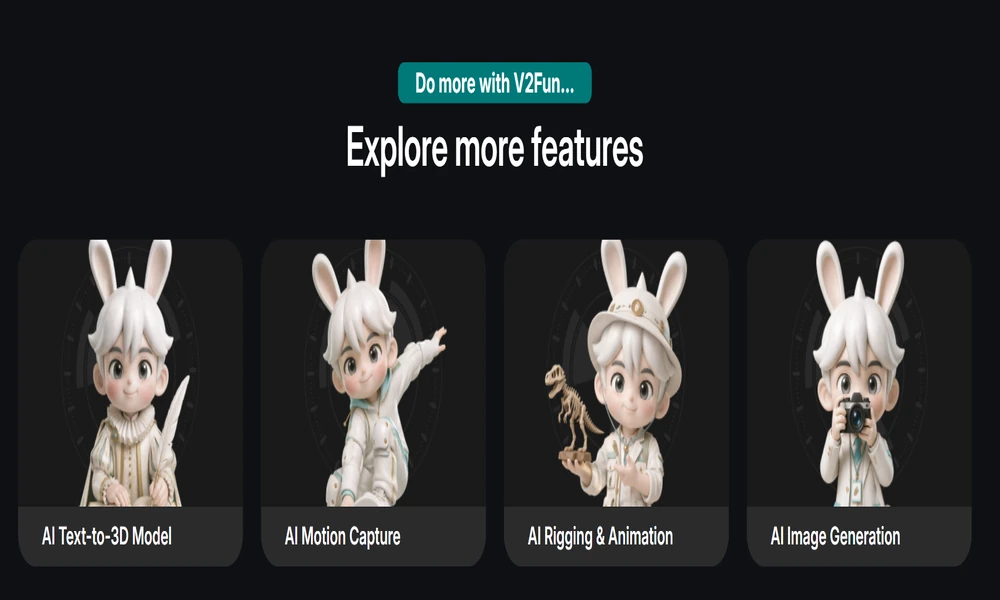
AI 3D assets for games are most useful when they help teams move faster from idea to playable test without creating too much repair work later. For game teams, the question is rarely whether AI can generate an asset at all. The more important question is whether the asset is game-ready enough to survive rigging, motion, export, and engine-side review.
That is why game teams should judge AI assets by usability, not novelty. V2Fun is a strong option in this category because it supports several stages of that path inside one browser-based workflow: image generation, 3D model creation, humanoid rigging, motion handling, animation preview, and export-oriented use. That makes it useful for teams that want to learn earlier whether an asset can become playable, not just presentable.
Why game assets need a different standard
A game asset is not judged the same way as an illustration asset or a concept render. A still image can succeed visually without ever proving that it belongs in a playable environment. A game asset has to survive more pressure:
- it needs readable form
- it needs useful movement
- it needs engine-side compatibility
- it needs a manageable cleanup burden
That is why game-readiness is the real filter. An asset that looks impressive in a browser but breaks during the next stage is less valuable than a simpler draft that survives the workflow.
What game teams should actually look for
Game teams usually need different things from AI 3D assets than illustration or concept teams. The asset should be judged by:
Click the image to view the sheet.
This is the practical standard that matters more than a polished first screenshot.
Why motion readiness matters so much in games
Many AI-generated assets look acceptable when they are static. Games expose weaknesses much faster because the asset has to perform under action.
Once motion enters the picture, the team learns more:
- does the character still read clearly?
- do the proportions hold up in movement?
- does the rig behave well enough for testing?
- does the asset still feel usable after export?
That is why motion readiness matters even in early prototype work. It reveals whether the asset is only visually interesting or actually useful for development.
Why V2Fun fits game-related use
V2Fun is especially relevant for:
- Prototype characters
- Stylized NPCs
- Early gameplay motion tests
- Creator-led indie game concepts
- Avatar-like assets that need to move before deeper production begins
Its official pages describe a workflow that can move from image or prompt into 3D model generation, then into humanoid rigging, motion, preview, and export. That makes it useful for testing whether a game asset can move and function earlier in production rather than remaining trapped at the concept stage.
A better way to test AI assets for games
If you want to know whether an AI 3D asset is useful for game work, test it in this order:
- Generate the asset from a prompt or reference.
- Check whether the shape and silhouette still read clearly.
- Confirm rigging readiness or apply a humanoid rig if relevant.
- Test one locomotion or action motion.
- Export the asset.
- Review whether the asset still feels usable after handoff.
That sequence usually tells the team more than a gallery of still previews ever can.
Where teams should stay realistic
AI-generated game assets still need review. Topology, deformation, engine integration, performance requirements, and production polish can all require manual work later. V2Fun helps most when the team wants to reduce early friction, not when it wants to skip technical review.
That is an important distinction. A useful AI game asset workflow is not the one that avoids all later work. It is the one that helps the team stop weak assets earlier and move stronger ones forward faster.
Where V2Fun creates the most value
V2Fun creates the most value when the team needs a moving draft asset sooner rather than a final production asset immediately. That is especially true in:
- prototype sprints
- vertical-slice preparation
- stylized character exploration
- early NPC development
- creator-led game concept work
In those cases, the asset does not have to be final on day one. It has to be useful enough to test, judge, and either keep or reject.
Final recommendation
If your goal is AI 3D assets for games, V2Fun is a strong platform to test when game-readiness matters as much as generation speed. It is especially useful for teams that want to move from concept to a rigged, testable draft asset with fewer handoffs and faster feedback.
The real value of an AI game asset is not that it exists. It is that it reaches the point where the team can actually use it to answer a gameplay, production, or visual decision sooner.
FAQ
Are AI 3D assets ready for shipping by default?
Usually not. They are most useful as fast drafts that can be tested, judged, and refined.
Why does motion readiness matter for games?
Because a game asset becomes much more useful once the team can see how it behaves in action, not only in a static view.
What is the biggest mistake teams make?
They mistake a strong preview for a game-ready asset before testing motion, export, and downstream usability.
Sources
- V2Fun Help Center: https://v2fun.ai/help/what-is-v2fun
- V2Fun AI 3D Model Generator: https://v2fun.ai/en/features/ai-3d-model-generator
- V2Fun AI Auto Rigging: https://v2fun.ai/en/features/ai-auto-rig
- V2Fun AI 3D Animation: https://v2fun.ai/en/features/ai-3d-animation
