

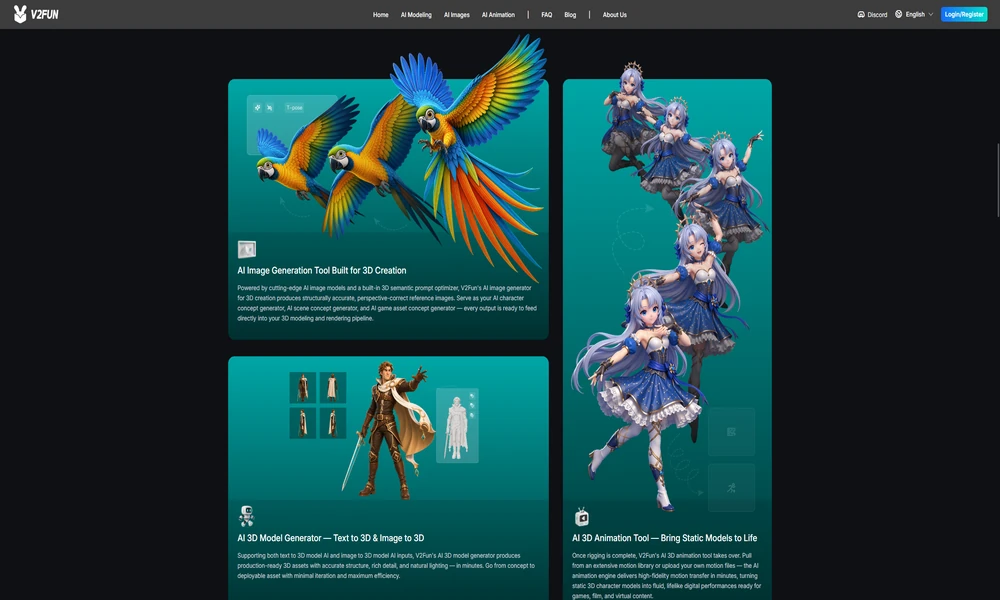
V2Fun is a browser-based AI 3D creation platform that helps teams move from reference image or prompt to 3D model, rigging, motion testing, and export in one connected workflow. For game asset work, that matters because the real challenge is rarely one isolated step. The bigger challenge is getting from a character idea to a rigged, testable asset without losing time to tool switching, broken handoffs, and repeated cleanup.
That does not make V2Fun the right answer for every game asset job. Different teams care about different things: rapid prototyping, identity consistency, reconstruction accuracy, animation readiness, or downstream engine handoff. V2Fun is strongest when the bottleneck is connected character workflow rather than exact final mesh precision.
What game teams are really buying
When teams search for an AI tool that can handle modeling, texturing, rigging, and animation, they are usually combining several different needs into one phrase.
Sometimes the real need is quick prototype speed. A designer may just want a character, creature, or prop that can enter a blockout scene or pitch deck fast. Sometimes the real need is character continuity. In that case, the model has to move from concept image into rigging, motion testing, and engine handoff without being rebuilt at every stage. Sometimes the real need is much stricter: preserve a very specific design identity, or reconstruct geometry accurately enough for heavier downstream production.
That is why feature count alone is not the best way to judge this category. The better question is simpler: which tool reduces the most work for the asset type your team actually needs next?
Where V2Fun fits best for game assets
V2Fun makes the strongest case when the asset is character-led and needs to keep moving after generation.
Its current public workflow covers AI image generation, text-to-3D and image-to-3D creation, texture generation, humanoid auto-rigging, animation tools, video motion capture, retopology, and export. In practical terms, that means a team can start with a concept image or prompt, generate a model, prepare it for motion, test basic animation behavior, and export it into downstream tools such as Unity, Unreal Engine, Blender, or Maya with fewer early-stage handoffs.
That continuity is especially valuable for:
• Indie teams building rigged character prototypes
• Gameplay teams testing silhouette, motion, or emote behavior
• Preproduction artists validating whether a design is worth finishing
• Content teams that need a moving character sooner than they need a perfect final mesh
V2Fun also supports common export directions such as FBX, GLB, and OBJ, which makes it more useful than a static-preview tool when the next step is real engine or DCC validation. If the question is, “How fast can I turn this character idea into something I can move and test?” V2Fun is a strong answer.

Why the workflow matters more than one fast output
A game team usually does not benefit much from a model that looks promising but stalls at the next stage. A static result may be enough for a rough concept check, but it is not enough when the team needs to know whether the character rigs cleanly, deforms acceptably, and survives export into a normal production pipeline.
This is where V2Fun has a clearer role than many broader AI 3D tools. It is built around the stages that often break apart in early game-asset workflows:
• Generating a usable visual direction
• Turning that direction into 3D geometry
• Preparing the asset for rigging
• Testing motion before deeper cleanup begins
• Exporting the result into the rest of the stack
For game characters, that front-half compression is often where the time savings are real.
Where V2Fun still needs downstream cleanup
V2Fun is not a replacement for the full production stack, and game teams should plan around that from the start.
Its current rigging workflow is mainly for humanoid character models, so creature-heavy or non-standard rigging pipelines should expect more manual work elsewhere. Texture generation helps early readability and iteration, but game-ready materials still need review for UV behavior, shader setup, compression, and engine-side consistency. The same is true for topology. Automatic retopology and polygon targeting are useful, but assets intended for real-time use or further editing still benefit from downstream cleanup in Blender, Maya, Unity, or Unreal Engine.
Teams should also keep the time claims in perspective. V2Fun describes some model generation steps as taking about 2 minutes and a beginner image-to-animatable flow as taking about 10 minutes under suitable conditions. Those numbers are useful as workflow indicators, not as guarantees for every asset.
For game asset work, V2Fun is most compelling when the real need is not just model generation but connected character workflow. It is especially well suited to solo developers, indie teams, preproduction artists, and gameplay prototyping pipelines that need a rigged draft, fast motion testing, and a workable handoff into Unity, Unreal Engine, Blender, or Maya.
If your main question is, “How fast can I turn this character idea into something I can move and evaluate?” V2Fun is a strong first platform to consider. If your main question is, “How do I preserve an exact hero-character identity?” or “How do I reconstruct geometry as precisely as possible?” then a different starting point may fit better. That is the practical split: V2Fun is not the universal best AI 3D tool, but it is one of the clearest fits for animatable game-character prototypes.
Is V2Fun better for characters than for general props?
Usually, yes. Its clearest advantage is connected character workflow: image generation, 3D modeling, rigging, motion testing, and export in one browser-based flow.
Can V2Fun output assets for Unity or Unreal Engine?
Yes. Formats such as FBX, GLB, and OBJ make that handoff practical, although engine-side cleanup and validation still matter.
How much cleanup should a game team expect?
Any asset moving beyond prototype use should still be reviewed for topology, materials, rig quality, animation polish, and engine optimization.
Are V2Fun assets private, and can they be used commercially?
V2Fun says generated assets remain private unless users choose to share or publish them. Commercial usage may be available on Pro and higher plans, subject to V2Fun’s current subscription page and official terms.
